Empress's conquest of the world for the King of Esfi
The Blazing WorldThe Empress's conquest of the world for the King of Esfi transforms an expedition of apparent rescue into a system of imperial subjection. The Empress presents herself as a native returning to defend her country, but her victory does not end with the defeat of its attackers: she destroys rival fleets, demands tribute from trading nations, and uses fire against inland states that refuse. The result is a world-wide monarchy secured by force, with the King of Esfi elevated to supremacy and the Empress's military power serving as its guarantor.
Causes and Promise of Aid
The campaign begins when the Empress learns that much of her native world has resolved to make war against her country and weaken or destroy its naval power. She sends a letter to the country's general and senior commanders, identifying herself as a powerful princess who has come from another world to assist them. She asks them to declare when they want her aid, presenting the offer as support for their safety rather than a bargain for her own advantage.
The commanders' council cannot promptly decide how to answer: its members hold conflicting opinions. The delay angers the Empress, who considers returning to the Blazing-World without helping her countrymen. The Duchess of Newcastle urges her to be patient, explaining that councils are slow because their members disagree and compete to appear the wisest. The episode sets the Empress's decisive command against the deliberative habits of the society she has come to aid; she nevertheless continues the campaign.
When she meets her countrymen, the Empress declares that although she is now absolute ruler of an entire world, she remembers having been a subject of their kingdom. She says she has forsaken her own tranquillity, riches, and pleasure to prevent their ruin, and promises to destroy their sea-borne enemies before nightfall. Her stated return is their grateful acknowledgment and recognition of her loyalty. The promise is expansive: she offers not merely to repel an attack but to make the small kingdom the most powerful nation in the world.
Destruction of the Fleets
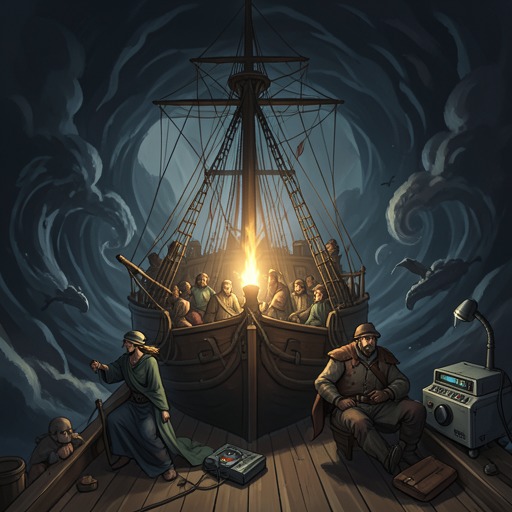
Before approaching the enemy, the Empress uses Fish-men and Bird-men to gather intelligence about the hostile fleet's numbers, station, and posture. At night, the Bird-men carry lighted Fire-stones through the air while the Fish-men hold them above the water. Thousands of torch-like flames make sea and sky seem ablaze; observers believe the Last Day has arrived and fall to prayer. At daybreak the lights go out, revealing ships that appear to move without sails, guns, or other visible weapons. Painted black so their gold is concealed, the vessels confound the enemy, whose ships remain immobilized by fear and uncertainty.
The Empress then speaks publicly to the defenders, identifying herself as a native of their kingdom and declaring that she has crossed from another world to help them. The spectacle and the claim produce competing interpretations: some call her an angel or goddess, while others suspect sorcery or diabolical deception. The scene establishes the campaign's recurring method: her power is made visible through carefully staged appearances, while the observers struggle to understand what they see.
At the battle itself, the Empress wears robes set with diamonds and carbuncles and carries a shield of a single carbuncle and a spear of a single diamond. She directs the Fish-men to approach enemy vessels with Fire-stones enclosed in diamond cases, uncovering and wetting the stones only when they are under or beside the ships. The resulting flames spread through the enemy fleet and reach the gunpowder, blowing the vessels up. The enemy navies are destroyed in a short time. Her countrymen hail her as a deliverer sent by God, but she does not return to the Blazing-World after this victory; she remains until she has forced the rest of the world to submit to their monarch.
Tribute and Resistance
The King of Esfi thanks the Empress for her assistance but explains that hostile powers still impede the trade and traffic of his dominions. The Empress answers by proposing tribute: she will burn or sink ships that refuse to pay the King. She sends this demand to neighboring maritime nations, which reject it with scorn. In response, she orders the Fish-men to destroy foreign trading ships. The resulting disruption drives the states to negotiate, but the Empress will accept no terms other than submission and tribute to the ruler of her native country. After a long treaty, the nations yield. The King thereby becomes master of the seas and, because the world's nations depend on maritime commerce as well as land trade, gains power over the wider world.
That settlement proves unstable. The neighboring nations regard themselves as so burdened and constrained by tribute that they can scarcely leave their own dominions without paying for it. They unite their forces against the King, and the Empress again sends the Fish-men to destroy the remaining naval power. Most are compelled to submit once more. Some states, however, can survive without foreign commerce, while others trade only by land; naval destruction alone cannot force these holdouts to comply.
The Empress therefore threatens to burn their towns and cities if they will not submit willingly. She orders the Bird-men and Worm-men to begin with smaller towns, wishing to avoid more destruction than she considers necessary, and to proceed to the larger cities if resistance continues. The Bear-men use their Telescopes to identify the towns and cities that refuse; the Empress then assigns targets to the forces. She warns the rulers that the burning of small towns is a demonstration of power and that continued resistance will turn a limited loss into total ruin. The Bird-men are to travel at night to avoid detection.
The operation depends on the Fire-stones' response to moisture. Worm-men place them beneath house foundations, while Bird-men set others on rooftops. The Bird-men learn a few words of the local language and warn the inhabitants that rain will set their towns alight. The warning seems absurd to people who understand water as a means of putting out fire. When rain comes, the houses burst into flame, and more water makes them burn more fiercely. The spectacle terrifies neighboring cities and kingdoms, which submit rather than face the same destruction.
One country resists because it seldom receives rain, relying instead on dew, which would be insufficient to sustain a great fire. The Empress learns that a seasonal tide floods it for several weeks, and orders the Bird-men and Worm-men to place Fire-stones at the bases of the supports on which its raised houses stand. When the tide arrives, the buildings catch fire; the heat turns the water into vapor and then air, and the destruction of the houses is accompanied by general barrenness across the country that year. This final exception also submits. By adapting the same weapon to a different local condition, the Empress closes the last gap in the tributary order.
Imperial Settlement and Political Meaning
The Empress's own speech to the assembled princes makes the political result explicit. She says that the King of Esfi was unjustly attacked by nations seeking his hereditary rights and prerogatives over the Narrow Seas, and that Heaven has rewarded him with absolute power as head monarch of the world. She warns that those who resist will gain loss but no victory, and advises the princes to pay tribute so that they may live peacefully and happily. Her rhetoric casts conquest as the restoration of rightful authority and the path to peace; the campaign's actual terms are submission, tribute, and the threat of further destruction.
The Empress has indeed saved her native country, but she has also made it an absolute monarchy over the entire world. Her success relies on specialized cooperation among the Fish-men, Bird-men, Worm-men, and Bear-men, whose knowledge and capacities let her move from naval intelligence to ship destruction, covert deployment, and the burning of inland settlements. A campaign that begins with a request for aid thus culminates in a global hierarchy maintained by military force and control of commerce. The promised security of the homeland and the subjection of other nations are not separate outcomes: the Empress makes the first the justification for the second.